

Castillo de Almansa Reserva Piqueras 2002


We take the quality of our wines very seriously, which is why all wines are reviewed when they arrive at our warehouse.
Quality check
We perform quality checks on all wines, examining the label, cork and seal, as well as the condition of the wine. This way we create the best conditions for the wine to still be good and drinkable.
Authenticity test
We work with skilled and trustworthy suppliers, and we perform authenticity tests on the wines when they arrive at our warehouse. Here we review the seal, label, bottle number and much more, so that we ensure that the wine is genuine.
We take our guide and service very seriously. When you order wine from us, you will receive a QR code with a link to everything you need to know about treating older wines. You can read more right here .
We select the wines based on strict quality requirements.
The wines must be from quality producers, stored according to all the rules of the art, and pass our final quality assurance when the wine arrives at our warehouse.
This ensures that we can offer a unique product where the probability of a unique experience is very good.
Read more about what to expect
Delivery: We ship orders every weekday.
Delivery time and price:
- Denmark: 1-2 days (39-49 DKK)
- Sweden: 2-3 days (150 SEK)
- Finland: 2-3 days (15 EUR)
- Germany: 2-3 days (15 EUR)
- Netherlands: 2-4 days (15 EUR)
- Generally for EU countries: 2-5 days (15-25 EUR)
NOTE: There may be 1-2 days longer delivery time in remote areas.
Returns: You always have a 30-day right of return.
NOTE : All orders from November 15th to December 24th can be returned until January 31st.
Castillo de Almansa Reserva Piqueras 2002
The 2002 Castillo de Almansa Reserva is a red wine produced by Bodegas Piqueras. Holding the Denominación de Origen (DO) classification, this Reserva reflects the viticultural traditions of its origin in southeastern Spain.
The wine comes from Almansa, a region located in the Albacete province of Castilla-La Mancha. Functioning as a geographical transition zone between the high central plateau of La Mancha and the Mediterranean Sea, Almansa was granted its official DO status in 1966. The vineyards are situated on a flat plateau at altitudes ranging from 700 to 1,100 meters above sea level. The climate is continental with distinct Mediterranean influences, leading to extreme temperature fluctuations. Summers can reach up to 40 degrees Celsius, while winters bring frost down to minus 10 degrees. With a sparse annual rainfall of just 250 to 350 millimeters, the vines grow in a dry environment where the well-draining soil predominantly consists of limestone with low organic matter, alongside areas of sand and stones.
This vintage is crafted from a blend of Tempranillo, Monastrell, and Garnacha. Tempranillo is a primary Spanish grape variety frequently cultivated in regions such as Rioja and Ribera del Duero. Monastrell, the Spanish name for Mourvèdre, is commonly found in areas like Jumilla, Yecla, and Alicante, while Garnacha, known internationally as Grenache, is widely planted across Spain, including Navarra and Aragón. During the production process, the wine was aged for 12 months in oak barrels before bottling, followed by an additional period of resting in the cellars of Bodegas Piqueras prior to its release.
The history of the wine
Below, you can delve into the history of this wine — its producer, grape, area, and region.
Almansa
Almansa is a Spanish wine region with the status of Denominación de Origen (DO), located in the southeastern part of the province of Albacete in Castilla-La Mancha. The area serves as a geographical transition zone between the high central plateau, La Mancha, and the Mediterranean Sea. The vineyards are primarily located on a flat plateau at an altitude of between 700 and 1,100 meters above sea level, where the soil predominantly consists of limestone with a low content of organic matter as well as areas with sand and stones.
The climate in Almansa is continental with clear Mediterranean influences. The region experiences extreme temperature differences with very hot summers, where temperatures can reach up to 40 degrees, and long, cold winters with frost down to minus 10 degrees. Precipitation is sparse, typically between 250 and 350 millimeters annually, which creates a dry environment for the vines.
Viticulture in Almansa can be traced back to the 16th century, and the region achieved its official DO status in 1966. The tradition is strongly rooted in the production of red wines, where the local grape varieties Garnacha Tintorera and Monastrell play a central role together with Cencibel, which is the local name for Tempranillo. Garnacha Tintorera in particular is characteristic of the area due to the grape's dark flesh, which distinguishes it from most other black grape varieties and has made it a cornerstone in Almansa's wine history.
When this wine was made, the world looked very different. Here are some of the stories that unfolded while this bottle quietly aged in its cellar.
You are in safe hands

100% authentic bottles
All bottles undergo a thorough authenticity test by our certified sommeliers before being offered for sale. We reject bottles we are unsure about.

Thorough quality check
Cork, capsule, fill level, label condition, and provenance are individually documented for each bottle. A physical certificate is included with every purchase.

60-day return policy
We are confident in the quality of our wines, and you as a buyer should be too. Return any unopened bottle within 60 days for a full refund — no questions asked.

4.7 on Trustpilot
277 customers have shared their experience. From the first email to the bottle arriving safely – we take pride in making a difference from start to finish.
How it handles
you your wine

Storage
Store the bottle horizontally at 12–14°C and avoid direct sunlight, vibrations, and temperature fluctuations.

Opening
Allow the bottle to stand upright for 24–48 hours before opening to allow sediment to settle. Use a professional corkscrew and open carefully.

Enjoyment
Serve at 17–18°C and be patient – there is a great difference in how and how quickly wines open up when they are aerated.
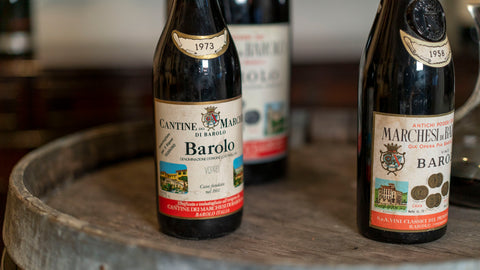
GUIDE TO THE GOOD WINE EXPERIENCE
We will help you throughout the journey. Here you can read our guide on how to treat the wine. If you have any questions, you are always welcome to write or call us.
Our customers say it best!
Based on 247 reviews